
Nervous system regulation burnout is possible. But if you’re reading this at 11 PM — exhausted, unable to sleep, mind cycling through the same loops — you haven’t found the right intervention yet. Exhausted, but unable to sleep. Your mind won’t stop cycling through the same loops. Your body feels heavy—a bone-deep fatigue that no amount of rest seems to touch. You’ve tried therapy. You’ve tried meditation apps. You’ve tried powering through on caffeine and willpower. Nothing sticks.
Your nervous system regulation has broken down—stuck in a chronic threat-detection mode that blocks genuine recovery. Until your nervous system regulation is restored, nothing else will work.
This isn’t a character flaw. It’s not a lack of discipline. Your nervous system is dysregulated—stuck in a chronic threat-detection mode that blocks genuine recovery. And until that changes, nothing else will work.
I know this because I’ve lived it. At 57, I suffered a stroke that shattered my nervous system. My heart rate variability (HRV) dropped to 22—severely dysregulated. Sleep was destroyed. My body couldn’t distinguish safety from danger. But I rebuilt my nervous system using clinical protocols grounded in neuroscience, and I measured every step of the recovery. My HRV normalized within 12 weeks. My sleep returned. My capacity to function was restored.
If I could recover my nervous system from near-zero after a stroke, you can recover yours from burnout. And here’s the critical point: it can happen in weeks, not years.
Here’s what’s actually happening in your body—and how to recover.
What Burnout Actually Does to Your Nervous System
Your vagus nerve is the longest nerve in your body. It runs from your brainstem down through your chest, heart, lungs, and gut. It’s the primary communication highway of your autonomic nervous system—the system that controls everything you don’t consciously think about: heart rate, digestion, breathing rhythm, immune response, emotional regulation.
When you’re functioning well, your vagus nerve maintains what neuroscientists call vagal tone—the capacity of your nervous system to shift fluidly between activation (responding to a challenge) and recovery (resting, digesting, regenerating). High vagal tone means your system is resilient: it can ramp up when needed and wind down when the threat passes.
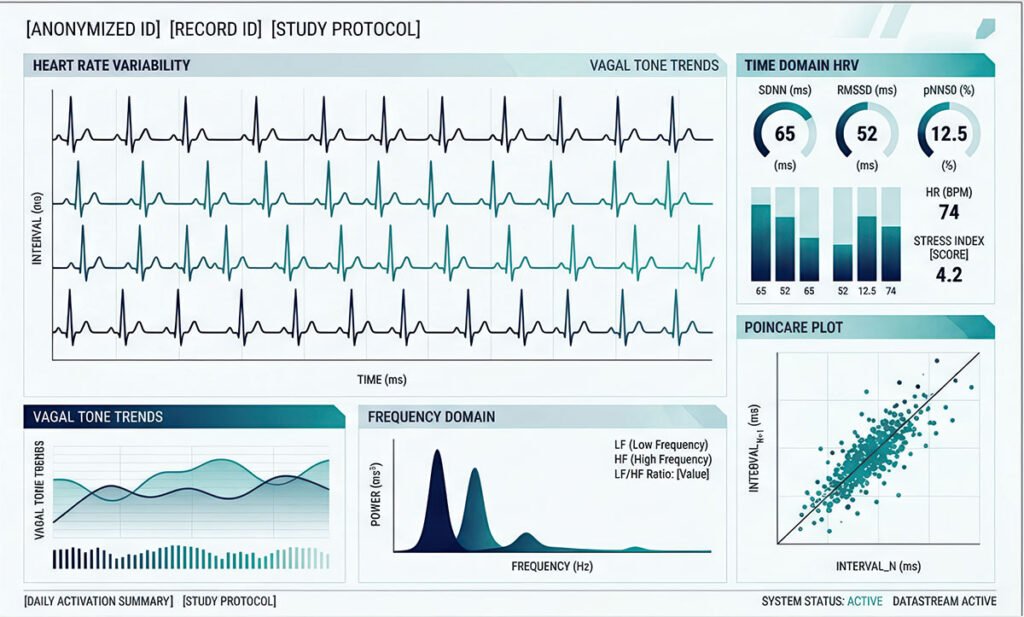
Chronic stress destroys vagal tone. When you’ve spent months or years in sustained high-alert mode—deadlines, decisions, pressure, sleepless nights—your vagus nerve essentially stops sending the “safe to rest” signal. Your nervous system learns that the world is perpetually dangerous. It stays partially activated at all times. This is dysregulation, and it’s measurable through HRV (Heart Rate Variability). Low HRV means low vagal tone. Low vagal tone means your nervous system is stuck.
This is why willpower doesn’t fix burnout. You cannot think your way out of a dysregulated nervous system. You cannot meditate your way out of it in ten minutes a day. The dysregulation is physiological. It requires a physiological intervention.
The good news: your nervous system has neuroplasticity. It can rewire itself. Recovery is the default trajectory—you just need the right stimulus to initiate it.
Free Clinical Assessment
Is your nervous system stuck in burnout?
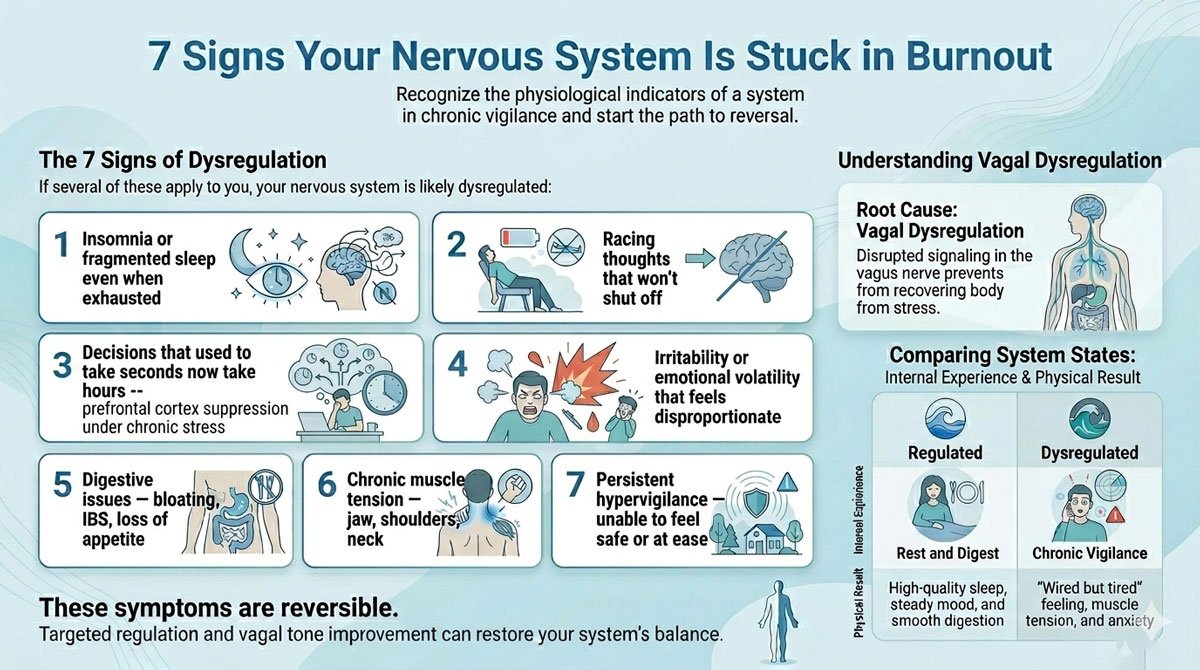
Download the free Burnout Nervous System Assessment — 7 clinical indicators your autonomic system is dysregulated, with a scoring guide and the physiological mechanism behind each one.
Get the Free Assessment →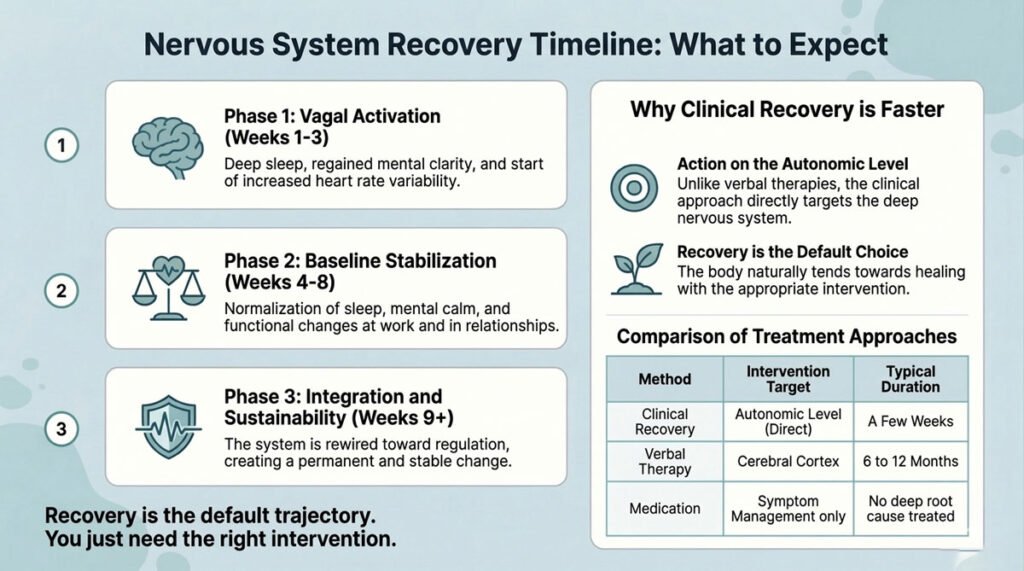
Proof of Concept: My Own Recovery
Post-stroke, I had severe vagal dysregulation confirmed by medical testing. My HRV was 22—well below the threshold for healthy functioning. Sleep was destroyed. My nervous system was locked in threat mode 24 hours a day. Conventional rehabilitation addressed motor recovery, but it did not touch the autonomic dysregulation.
When I applied clinical nervous system regulation protocols to my own reconstruction—protocols grounded in polyvagal theory and vagal stimulation—my HRV improved within 4 weeks. Within 12 weeks, it reached 65 (healthy range). My medical team measured it. This wasn’t placebo. This was measurable, reproducible nervous system change.
Ready to start your recovery?
Check If You QualifyMy Approach: Clinical Nervous System Regulation
I approach nervous system regulation with engineering precision — defined protocol, measurable inputs, measurable outputs. Not a wellness coach. Not a motivational speaker. I approach nervous system regulation the way I approach any complex system: identify the mechanism, understand the dysfunction, apply a precise intervention, measure the outcome.
My work is grounded in three pillars of established neuroscience:
- Polyvagal Theory (Stephen Porges)—how your vagus nerve registers safety and threat, and how to shift it from one state to the other
- Heart Rate Variability research—the gold standard for measuring nervous system regulation, validated across thousands of peer-reviewed studies
- Neuroplasticity—your nervous system’s proven capacity to rewire itself when given the right stimulus
This is not intuition-based work. There is a defined protocol, measurable inputs, and measurable outputs.
What Happens in a 50-Minute Session

Assessment. I evaluate your current nervous system state—your presentation tells me whether you’re operating from a freeze response (shutdown, dissociation, exhaustion), fight response (hypervigilance, anxiety, irritability), or a fluctuation between both. Most burnout clients arrive in freeze.
Vagal stimulation. I work directly with your nervous system using a clinical protocol designed to activate the ventral vagal pathway—the branch of your vagus nerve responsible for safe social engagement, rest, and recovery. You may feel warmth, tingling, deep relaxation, or you may feel nothing physically obvious during the session and notice the effects afterward.
Nervous system re-education. I explain what happened physiologically so your brain learns to recognize and sustain the regulated state we’ve created. This is critical: understanding the mechanism accelerates recovery because your nervous system stops interpreting the shift as unfamiliar or threatening.
That night, most clients sleep deeply for the first time in months. The next day: mental clarity, physical ease, a sense of groundedness. Within 4 weeks of consistent sessions, your baseline has shifted. You feel recovered.
What to Expect Week by Week
Session 1 (Day 1): You arrive exhausted and likely skeptical. The session is subtle—no massage, no needles, no dramatic physical sensation. Your nervous system is registering input that your conscious mind may not immediately detect.
Night 1: Most clients sleep through the night for the first time in months. Real, deep, uninterrupted sleep. This is the first signal that your vagus nerve is responding.
Day 2: Mental clarity. A sense of ease you may not have felt in a long time. Your body feels lighter. Breathing feels easier. Your nervous system has made its first measurable shift toward regulation.
Weeks 1–4: Sessions continue at a rhythm of 1–2 per week. Your sleep normalizes. Racing thoughts decrease. Energy stabilizes. HRV improves measurably. By week 4, the changes are consistent and noticeable in your daily life.
Weeks 5–8: Your new regulated baseline consolidates. Most clients need 4–8 sessions total over this period to establish a stable recovery. After that, maintenance is simple: one session per month, or less.
What Clients Say
The following testimonials were collected during an earlier phase of my practice. The modality has evolved — the results have not.

“I had been dealing with a chronic physical condition for years — six years of conventional treatment that provided a band-aid at best. My session with Vincent was scheduled for 30 minutes. Within minutes, I felt a release throughout my entire body. The symptoms cleared. Weeks later — still clear.”
— Nancy Squier, Scottsdale, AZ, USA

“I felt quite lost, stuck, and in pain. After working with Vincent, I now feel centred, calm, and functional in a way I hadn’t for a long time. The recovery was faster than I expected.”
— Valerie Brockbank, Los Angeles, USA
Frequently Asked Questions
Is this real science, or is it another form of alternative wellness?
It is science. Nervous system recovery works through well-documented physiological mechanisms: polyvagal theory, vagal tone regulation, and HRV improvement. These are peer-reviewed, measurable outcomes — not subjective impressions. Your sleep improves. Your anxiety decreases. Your HRV normalizes. These changes are objective and reproducible.
How fast will I actually see results?
Most clients experience noticeable relief after their first session — particularly in sleep quality and mental clarity. Consistent, measurable improvement (normalized HRV, sustained energy, reduced anxiety) typically appears within 4 weeks of regular sessions. Compared to talk therapy, which often requires 6–12 months for comparable nervous system shifts, this is dramatically faster.
What if it doesn’t work for me?
My protocol is structured: 4 sessions over 4 weeks. If you are not experiencing measurable improvement by week 4 — better sleep, lower anxiety, increased energy — we reassess. We either adjust the protocol or determine that a different approach is more appropriate for your situation. Most clients do experience improvement. If you don’t, you’ll know within a month.
Is this a substitute for therapy or medication?
No. Clinical nervous system recovery is complementary. If you are working with a therapist, this approach accelerates recovery in ways that talk therapy alone doesn’t — because it operates at the autonomic nervous system level, not the cognitive level. If you are on medication, continue it. Many clients find that as their nervous system regulation improves, they can discuss adjustments with their doctor.
Research References
Porges, S. W. (2011). The Polyvagal Theory: Neurophysiological Foundations of Emotions, Attachment, Communication, and Self-Regulation. W. W. Norton & Company.
Task Force of the European Society of Cardiology and the North American Society of Pacing and Electrophysiology. (1996). Heart rate variability: Standards of measurement, physiological interpretation, and clinical use. Circulation, 93(5), 1043–1065.
Tracey, K. J. (2009). Reflex control of immunity. Nature Reviews Immunology, 9(6), 418–428.
Merzenich, M. M. et al. (2014). Brain plasticity-based therapeutics. Frontiers in Human Neuroscience, 8, 385.
Free Clinical Assessment
Is your nervous system stuck in burnout?
Download the free Burnout Nervous System Assessment — 7 clinical indicators your autonomic system is dysregulated, with a scoring guide and the physiological mechanism behind each one.
Get the Free Assessment →